
© 2026 Buckland Newton Community Website Committee Last updated 29th September 2026 09:50 Website design and update by Jeremy Collins
Holy Rood Church
People have worshipped at a church on
this site since at least the 13th Century,
when the earliest part of the current
church was built. Countless
generations have used this place for
baptisms, weddings, funerals and in
their daily service, worship and prayer.



Buckland Newton Community Website

in the heart of rural Dorset
From The Vicar - April 2026
I have a question. Is there sufficient need, demand or requirement for Buckland Newton Church? All the other places of worship in the village closed some years ago and now are houses or a shop. I am at retirement age, most of the congregation are a little older. The PCC are six of your friends and neighbours. They have been struggling with a £12,000 per annum deficit in support for years and have depended on the Dibben bequest to balance the books. But decades have passed, and the Dibben bequest is around £90,000, and the chancel roof has failed. You may have attended the many Coffee Mornings, Christmas Fairs, Teddy Zip-Wire Challenge, Concerts, lent Lunches and Cream Teas the PCC six have put on, organised, cooked and prepared. We are most grateful for your support. We have raised around £30,000, but expenditure- insurance, heating, repairs and professional fees to address the roof repairs keep growing almost as fast. Buckland Newton Church needs £120,000. The PCC six have researched and applied for outside support and have promises of £20,000 in grants. So- is there sufficient need, demand or requirement for Buckland Newton Church? Should we keep going? Do you mind if we just say “Well, we did our best”? At present, you have a public open service in the church every week. Might you come along? Or could we give it a rest? You can be baptised, married or buried in Buckland, and the graveyard is PCC maintained. At present the ancient building nestles in the Lydden Vale as part of your Landscape and View. Will it matter to you if it is locked and barred because there is no one to maintain it, and the burial ground closed? It would be very helpful to know, because the burden upon the PCC six has been long and heavy, and we could do with some help in heavy lifting. Jonathan cernevicar@gmail.com Why are we fundraising for Holy Rood? Centuries old churches such as Buckland Newton’s Holy Rood are often at the heart of the village landscape. The stone walls, stained glass windows and surrounding churchyard add to the village’s visual charm and character. The ringing of the church bells is more than a call to worship, it’s a familiar, comforting sound that marks time and celebrates life events, from weddings to harvest festivals. Hearing the bells drift across the village on an evening or Sunday morning adds a rhythmic, peacefulness to village life. The historical significance of these old churches connects the present community to the past, with memorials and unique architecture that serve as living records of local history. Beyond services, village churches often host events and gatherings for all, whether they attend services or not, providing a sense of continuity and belonging for the whole community. All of the above show that you don’t have to be a regular worshipper in order to appreciate or benefit from your village church – it is there for you. Of course, all are always welcome! As we know, many rural areas have declining church congregations due to population shifts and ages. This, of course, means lower weekly donations and with a small congregation, there is simply not enough financial support to cover large, unexpected bills. Old church buildings are costly to maintain and roof repairs, like the one needed at Holy Rood, can run into tens of thousands of pounds, which is far beyond the means of a small rural congregation. Church authorities, therefore, can decide to close rural churches to focus resources on larger, more sustainable congregations, especially when a costly repair such as this arises. If you appreciate your village church in whatever capacity, whether it’s the beauty of walking your dog through the churchyard and down the footpath towards the pub, hearing the church bells chime on a summer evening, attending a carol service at Christmas or simply as an important historic building, we are asking for your help. Please support our fundraising events to help reach the sum needed to save our church roof. Thank youThe Benefice
The parish of Buckland Newton is part of the benefice of Buckland Newton, Cerne Abbas, Godmanstone and Minterne Magna. The vicar, Rev. Canon Jonathan Still lives in the vicarage in Cerne Abbas ( Tel: 01300 341 251, cernevicar@gmail.com ) Sunday 27th September, 3.00 pm, Buckland Newton Village Hall. Holy Rood Church Community Meeting. Shape the Future of Holy Rood Church. This is your chance to voice your views and opinions on this amazing, historic building at the heart of our village. Spare a moment to think of the times you have sat in a pew for a special event, would you mind if it wasn't there? Holy Rood is vulnerable and needs help, our help, everyone's help. This is not just another church, it is Our Church in Our Village, and we very much want this much-loved building to remain at the heart of the village life that we love. Holy Rood is ours, it belongs to us and its future depends on us. Please come to these community meetings with your questions, criticisms, ideas and thoughts, we must work together for everyone's sake. If you cannot make this meeting, there is another opportunity on Saturday 10th October, also at 3.00 pm in the Village Hall.Safeguarding Policy
Our Parish is committed to safeguarding children, young people and adults from harm. We follow the House of Bishops guidance and policies and have our own Parish Safeguarding Officer (PSO). Our Diocese’s safeguarding pages contain vital links and information including contacts for the Diocesan Safeguarding Advisor who advises our PSO. If you are concerned that a child or adult has been harmed or may be at risk of harm please contact the PSO Val Champion valchampion1052@outlook.com or the Diocesan Safeguarding Advisor Jem Carter jem.carter@salisbury.anglican.org. If you have immediate concerns about the safety of someone, please contact the police and your local authority’s children or adult social care services.From Holy Rood PCC
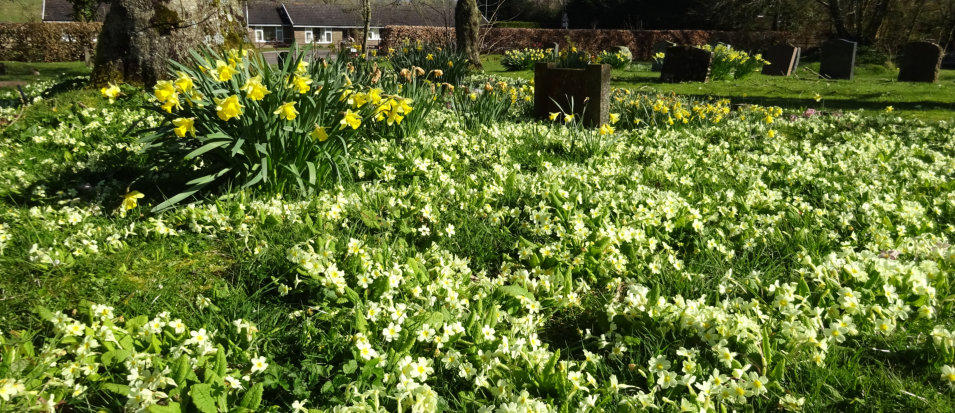
We kindly ask for the support of the Buckland Newton community in helping to meet the costs for the cemetery, located in the centre of the village opposite Cranes Meadow, which is a shared place of remembrance for many families. The ongoing upkeep of the cemetery—including grass cutting, pathway maintenance, maintaining the beautiful wildflower area and general care—requires regular funding that the church alone struggles to meet. Any contribution, however small, would help ensure that the cemetery remains a beautiful, peaceful, dignified, and well-maintained space for current and future generations. If you feel able to make a contribution, please contact the church treasurer Diana Wells via email: holyroodpccbucklandnewton@gmail.com Thank you - we are very grateful for all the continued goodwill and support of our community. The Parochial Church Council of Holy Rood Church, Buckland Newton.From the Vicar - March 2026
Dear Friends, I am excited to announce that we are to have an Easter present a little early. Fr Rob Sawdy has completed his training for ordination in the Winchester Diocese and has completed his curacy training in Bournemouth Town Centre Parish. Professionally, he is a Consultant Obstetrician and comes to us as a Volunteer or Non-Stipendiary Minister. This means, in effect, that he is pure gift of himself, through God to us in Buckland, Cerne, Godmanstone and Minterne. His wife Audrey is a Consultant Gynaecologist, and they have four very lively children. The family live in Milborne St Andrew. I hope they will have time to add a note about themselves to this issue, but please welcome and greet them as you see them about. Jonathan Hello! My name is Rob Sawdy, and I am a curate in Bournemouth soon to join Jonathan and the team here in the Cerne Valley Benefice. I have lived in Milborne St Andrew with my wife Audrey and our four children, now aged 20-25, for the last 23 years. We both work in the NHS as hospital consultants in Women' s health, practising mainly in maternity at DCH and UHD Bournemouth. I work Monday to Wednesday for the NHS and hope for the rest of the week to be available after Easter in the Benefice to get involved in whatever needs doing. I aim to spend a few months travelling the Benefice and meeting with those who want to share thoughts and interests about community life and the activities that bring people in from the margins to the heart of life together. I was convinced of the trust and love that Jesus shares with me and everyone from a very young age, being part of a small but tight knit all- age church that met for tea and toast after traditional BCP Eucharist in the City of London. A church that confused but enthused me, in equal measure, which bred a desire for language and meaning that explained better than I could who God really is and what I must do in response to this - to Him, to others, to myself. This alongside a lifelong acquaintance with medicine led me to a fuller understanding of healing and wellness. Being a Priest seemed the last thing in mind for me to be getting involved in and I was successful in avoiding the question until I was near 50. I have enjoyed serving in other not dissimilar vocations, such as being Chairperson to a number of charities and community organisations, including our village pre-school nursery. I was a reserve Army medical officer from the mid 90s until recent times, serving regiments in London and Dorset before deploying as a surgeon and later becoming MOD lead in Women’s health. I have also been a church musician since I was able to stand and love all things group orientated and musical in and out of church. Life in Bournemouth has given me a very varied training and Jonathan and I have found we share many similar passions, and he has opened the door to a few new ones! I am very much looking forward to working with Jonathan and understanding how rural ministry works and helps communities and people thrive in their lives together, following the example set us in Jesus Christ. That means getting to know as many of you as I can in the coming months and listening carefully. Please forgive me, I have a terrible memory for names but not faces! Do stop me and suggest a time we might get to chat. RobHoly Rood Church at risk?
from the Vicar, Jonathan Still: Dear Friends, We have some news on the condition of Holy Rood Buckland Newton Chancel roof! The good news is that the initial tests have shown that there is no asbestos present. Removal of the ceiling panels has revealed is that they have been acting as traps for condensation moisture. Water vapour has been able to enter into the space behind where the oak boarding supports the lead roof covering directly above. The vapour has then condensed into liquid water on the underside of the relatively cooler northern face of the roof. This moisture has allowed the development of localised areas of bacterial and fungal rot in the timbers over a long period. Because of the weight of the timber and lead covering, this will not be able to be done from inside. It appears therefore that an external scaffold roofing over the chancel will be required to enable the replacement of the areas of rotten timber, and then the replacement of the lead roof incorporating some vents to enclosed spaces. The chancel is the oldest part of Holy Rood. It has been here since being built by Glastonbury Abbey in the C13th. We have a plan to remedy the problem. Then we will have to work out how the remedy can be funded, so expect to hear more from me! The problems with the chancel roof were found when our architect carried out his Quinquennial Survey and this also identified various repairs needed to the roofs, stonework and rendering, etc. these need to be addressed over the next 1 to 4 years. The PCC members together with our architect will be addressing these items shortly and some may be incorporated with the chancel roof works. I remain very grateful to the small team of Buckland people keeping Holy Rood alive and flourishing. Our services continue at 10am 1st, 2nd and fourth Sundays and 4pm on 3rd. We have several weddings booked for 2025. It is always lovely to see you there.Services
For the service pattern, please see the Church Services page. You will be made very welcome at any of our services. Please feel free to visit the church at any time - it is usually open to visitors or for private prayer from 9.30 am to 5.30 pm.Looking for your ancestors?
A list of the gravestones in the Churchyard (now closed for all burials except the interment of ashes) and in the separate lower Burial Ground (near the school) has been compiled by the Online Parish Clerk (OPC) website at http://www.opcdorset.org/BucklandNewtonFiles/BucklandNewton.htm and may also be viewed by clicking on the links to the left. There are also plans of both the Churchyard (originally prepared by West Dorset DC) and the lower Burial Ground, and tables cross-referencing the plot numbers on the Churchyard and lower Burial Ground to the names on the graves. These again can be accessed through the Graves links to the left and may contain more recent information. Please note that the cross- referencing of graves plan in the churchyard and the names on the gravestones is an ongoing process, as deciphering some of the gravestones is proving time-consuming. A particularly poignant memorial is the small stone pillar with four panels, to the north of the church and close to the boundary hedge. This commemorates 13 local children (the youngest aged 10 months) and one adult who died in an epidemic of either cholera or typhoid in 1858. This year was known nationally as ‘the year of the Great Stink’. Presumably unusually hot weather produced a nationwide epidemic.The Chancel
"The most notable 13th century building (in central Dorset) is the Chancel of Buckland Newton, which although restored is sophisticated work for a village church." (Royal Commission on Historical Monuments). The north wall and its windows (not the glass) are original, but it is possible that the south wall may have been rebuilt as it is seven inches thinner. The door is certainly later, and the walls were probably heightened when the nave was built. In the 19th century the east window was replaced twice, in 1841 and 1869, and the Chancel re-roofed using the carved corbels which speculators have confidently identified as Henry III, his Queen, the Bishop the Lord And Lady of the Manor and the mason! On the north wall of the Sanctuary is a baptismal robe of about 1650. The altar and reredos were designed by a Mr Tolhurst of Mowbrays and dedicated in 1927. The Church is dedicated to the Holy Rood, or Cross, but the Rood Screen which once divided the Chancel and Nave has now gone - possibly at the time of the Commonwealth when James Sparing, Thomas Hall, and John Weeks were in turn appointed to the parish by Oliver Cromwell, Lord Protector. The stone stair which led to the Rood loft can be seen on the north side of the arch and it is suggested the priest used to climb up there to sing the Gospel, or maybe to preach, before the days of pulpits.Nave
This is late 15th century. Note the way in which the arch of the north door (the 'Plush' door) which the people from Plush used to use before they had a Chapel of their own) has been 'tailored' into the base of the window above. There used to be a window over the Chancel arch, but the old roof was higher, and badly designed. There were no tie bars, and it pushed the walls apart. The south arcade still has a visible lean. The 19th century roof is lower, and did away with the window. In the 1878 restoration they renewed the floor, built a boiler house, and repositioned the font and the entrance door to the room over the porch. They made new pews incorporating the 15th century oak bench ends, belonging to seats of "most uncomfortable construction", and they removed all traces of "a hideous gallery extending the whole width of the Nave and Aisles at the west and of the Church, and said to contain 120 sittings". The stonework and plaster were renovated, the lime wash removed, and the walls distempered. The pulpit panelling is 18th century, as is the old oak chest. A brass plate on the west wall commemorates a 17th century ancestor of the Dorset poet William Barnes (who attended the reopening in 1878). The curious Poor Box is 16th century and the Font is a Century older still, the same age as the Nave itself. When restoring the Nave a century ago, traces were found in the northwest corner of an earlier Nave, and it has been suggested that the arch leading into the Tower, off-centre and Decorated rather than Perpendicular in style, may have been part of it too. Over the door is set what is perhaps the oldest piece of stone carving in these parts - 7th or 8th century. It was found in the Vicarage garden in 1926, and is secular rather than religious.Porch
This is also 15th century, with a chamber above said to have been use by visiting clergy when the parish was served from Glastonbury. Over the door into the Church is a 12th century representation of Christ in Majesty previously set in a niche high on the tower.Tower
There are six bells in the Tower, two of them from the time when John Phillips was Vicar. They are dated 1581 and 1609 and replaced an earlier peal of five. The sixth bell was added when all were re-hung in 1913. All the bells and mechanisms were overhauled in 2012. The clock is a Jubilee Clock bought for the Diamond Jubilee of Queen Victoria. It cost £120. Further information can be found here about the Clock and Bells.Other Features
The window glass is all modern, but in the Nave good quality quarry glass set in lead was put in a century ago to replace the cheap domestic panes that were then there. The East Window depicting the Epiphany Resurrection and Ascension of our Lord, is in memory of James Venables (Vicar 1805-1850) (he must have put in the 'hideous gallery' in 1821; NB not the present organ loft). The north Chancel windows which show raisings of the dead in Old and New Testaments are in memory of Arthur Elton, curate, who died of a fever after losing his way one November evening in 1863 when walking back over the hill from Plush Chapel. The windows on the south side of the Chancel show St. Andrew, patron saint of Wells Cathedral and St. Peter and St. Paul patron saints of Bath Abbey, and are in memory of Archdeacon Gunning (Vicar 1850-1860). The west window (by Kempe) under the tower completes the century of clergy glass, showing St. Gabriel, St. Michael & St.Raphael in memory of Canon Ravenhill (Vicar 1860-1907) who directed the last restoration and was Rural Dean for twenty-five years as the brass lectern shows. Outside, notice the sundial set askew over the Porch and in the Churchyard several table tombs with inscriptions barely legible some from the 17th century. Registers When it became law that Registers must be kept, John Phillips himself a public notary was Vicar of Buckland Newton. The Register which he made, starting with entries for 1568, is a work of art and in fine condition. This, together with all Registers and Documents relating to the Parish may be seen in the Dorset County Archives, just below the Public Library car park at County Hall. There is an interesting volume kept by the clergy in the 19th century; churchwardens accounts; plans and builders' specifications; newspaper accounts; Constable's Warrants; tithe papers and the accounts of the Overseers of the Poor - and many other items.War Memorial
The War Memorial in Buckland Newton Churchyard commemorates those villagers who lost their lives in the two World Wars. Recent research has filled in some of the details of those named and this information can be viewed here. Restoration "The outside of the Church is covered with Roman cement which gives a very unsatisfactory and unchurchlike tone of colour to the exterior but judging from the materials with which the interior of the Tower walls are built I cannot doubt that this was found a necessary precaution against the driving weather to which this Church is exposed and I should be afraid to advise its removal." So wrote the Diocesan Architect to Canon Ravenhill in 1864.The removal of rendering from the outside helped to dry out the walls where moisture had been trapped behind faulty rendering; The Diocesan Advisory Committee for the Care of Churches in January 1977 strongly advised replacement of the rendering. In their view the soft rubble with which the walls were built has always had, and will need to have, a good protective finish. The process of hacking off and replacing all the defective rendering has now been completed, finishing with an even, slightly warm tone which will weather attractively. The interior has also been replastered and the distemper replaced with a limewash which is the ancient finish greatly to be preferred on all counts. The village of some two hundred dwellings would find it difficult to meet the cost of all this without outside help however economically the work is done. This is a problem in common with most village churches in the County. Fortunately, through a most generous bequest by Tom Dibben, all of this work is now complete. The people of the village continue do their best in a variety of ways and many social and fund raising events are held to support the church. Sources of Information Royal Commission on Historical Monuments, Dorset Vo1.3 Pt 1. Hutchins 'History of Dorset'; Mayo 'Buckland Newton Parish Register'; Dorset Natural History and Archaeological Field Club Vol. X page xxiii, Vol. XXVIII, page lvi, Vol. X, page 97; Victoria County History, Vol. 2, pages 35,38,142,250; Somerset and Dorset Notes & Queries Vol. XII page 80 and HOME NEWS Vol.1, page 87. Documents in the Salisbury Diocesan Record Office.


